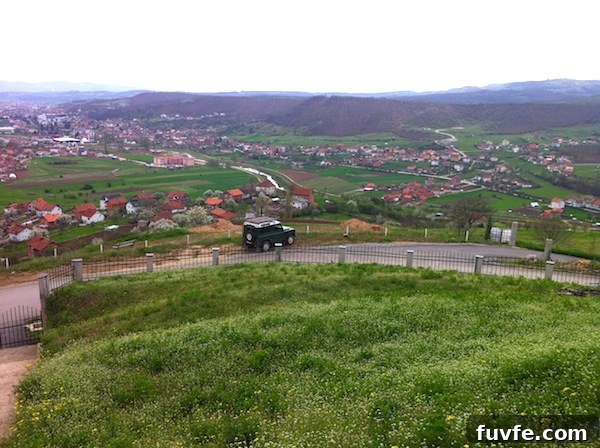
When I travel I always pay attention to gardens — they teach me a lot and spark fresh ideas. You might remember what I learned from a special Arizona garden last year. On my recent trip to Kosovo and Greece I did the same: while Brian photographed odd and amusing sights (I’ll save those for a separate post), I focused on the gardens. This week I’ll share what I found in Kosovo, specifically the village of Kamenica pictured above; next week I’ll write about Athens.
From that vantage the village looks pastoral, and the outlying countryside is indeed rural. The main settlement, though, feels more like a small town: there are multi-story apartment buildings, larger grocery stores, and a mix of commercial and single-family properties on modest lots.
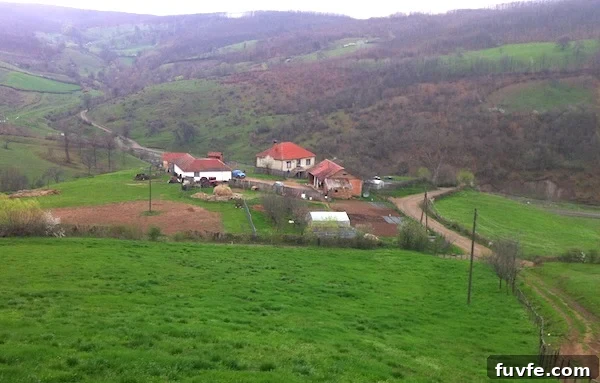
We visited a typical farm with a couple of houses (often more than one family shares a farm), a barn, garden plots, a plastic-covered greenhouse, and pasture for animals. It was mid-April, so most beds were plowed but not yet planted except for onions. The climate and spring soil conditions felt very similar to the Pacific Northwest — trees and tulips were in bloom.
At this point you might be thinking: “Okay, so it’s a farm. What’s the takeaway?”
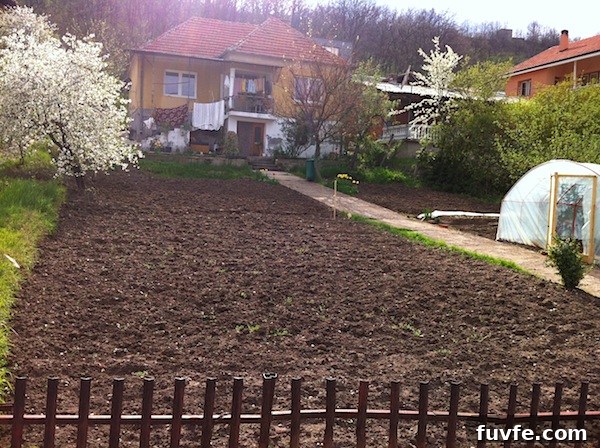
The key observation is simple but striking: the majority of houses on regular lots in the village use almost every bit of available ground to grow food. Roughly 80–90% of occupied yards looked like the photo above — a couple of fruit trees, a plowed yard ready for planting, and a small plastic greenhouse with young starts inside. In fact I’d estimate that around 98% of the homes that are lived in year round have a productive front or side garden and some form of greenhouse. (Many houses are vacant for most of the year because owners live abroad and return only seasonally.)
So practically every household cultivates food and nearly every garden includes a greenhouse.
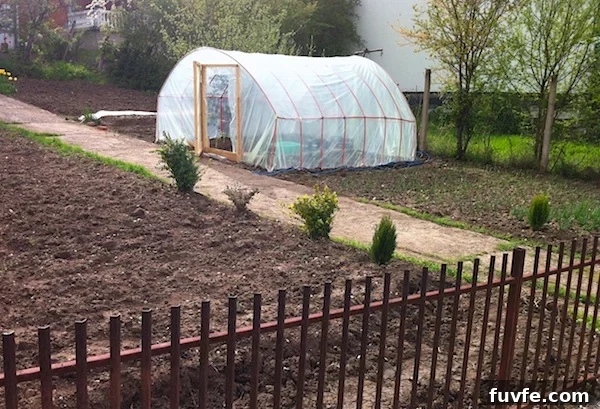
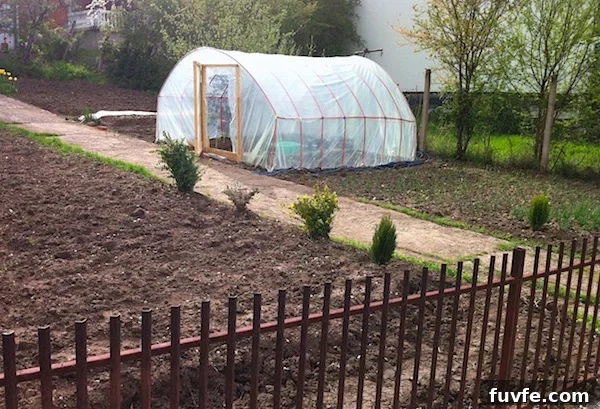
Those simple greenhouses were the most inspiring part. Back home I’d assumed greenhouses require a large investment — heaters, fans, automated vents, thermostats. In Kamenica they use very basic pipe-and-plastic structures, often without formal doors, to extend the growing season and protect young plants. These makeshift houses allow families to start tomatoes, peppers and other warm-season crops earlier and more reliably.
If you look into the doorway of the greenhouse above you can see tomatoes planted directly in the ground inside, and because the day was mild the entrance is propped open. I also saw greenhouses with strawberries and lettuces already producing. Outside, beds of onions were visible and there were small potato hills behind other greenhouses.
The people I met were resourceful, making the most of the land and tools they have to feed their families. They also trade and share ornamental plants and flowers, adding color and beauty to functional spaces. Driving toward Pristina we passed village after village with the same pattern: plowed ground ready for planting, young fruit trees, and rows of plastic-covered houses.
The lesson is straightforward and practical: use what you have or what you can obtain cheaply to grow food for your household. Seeing how efficiently locals use small plots inspired me to rethink my own property and how I might use it more productively — and to consider building a simple greenhouse like the ones I saw in Kamenica.
Has anything in your garden inspired you lately?