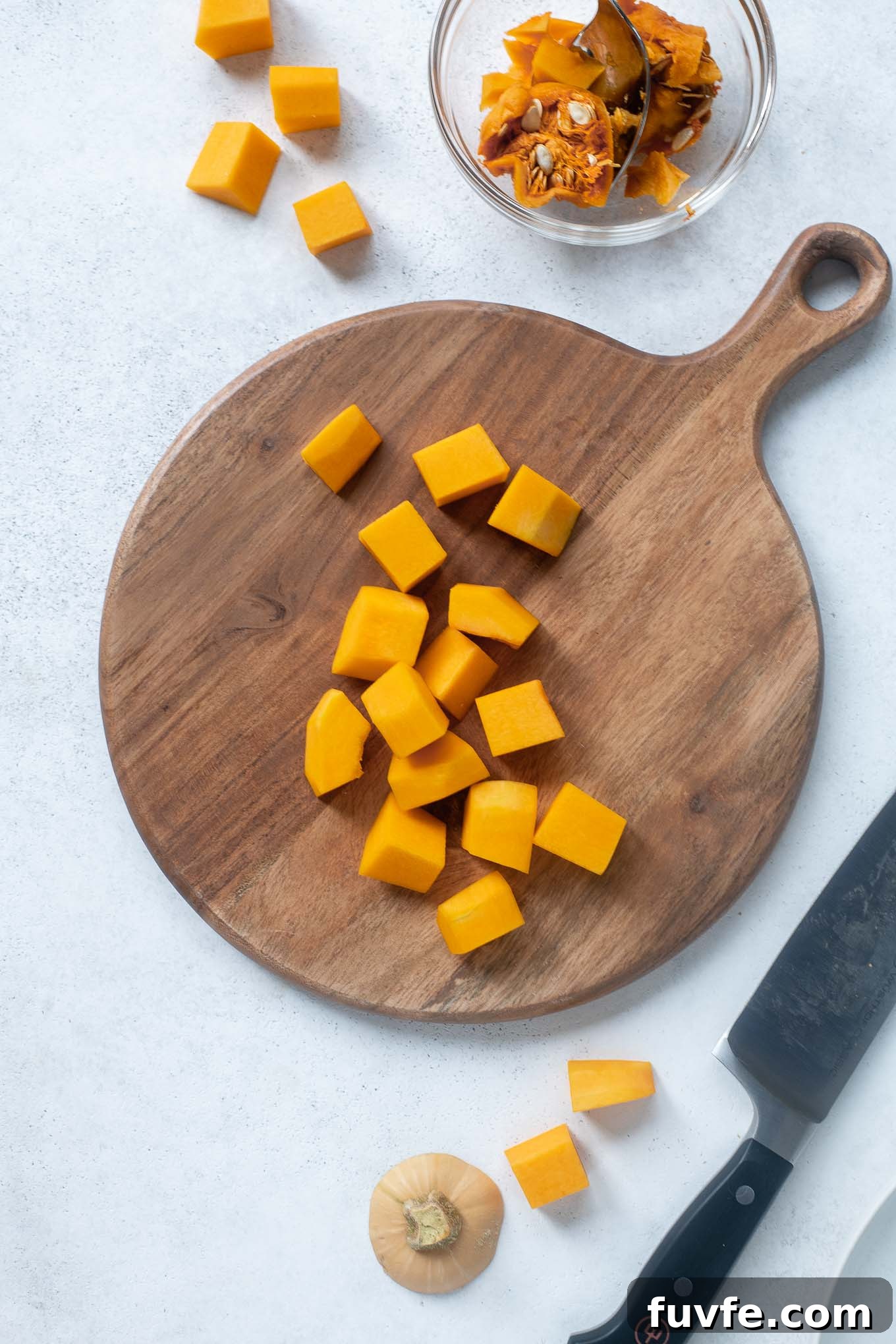
Learn how to peel and cut butternut squash quickly and confidently with these clear, step-by-step instructions. Preparing and cubing your own butternut squash saves money, gives you fresh, uniformly cut pieces for recipes, and lets you freeze portions for later use.
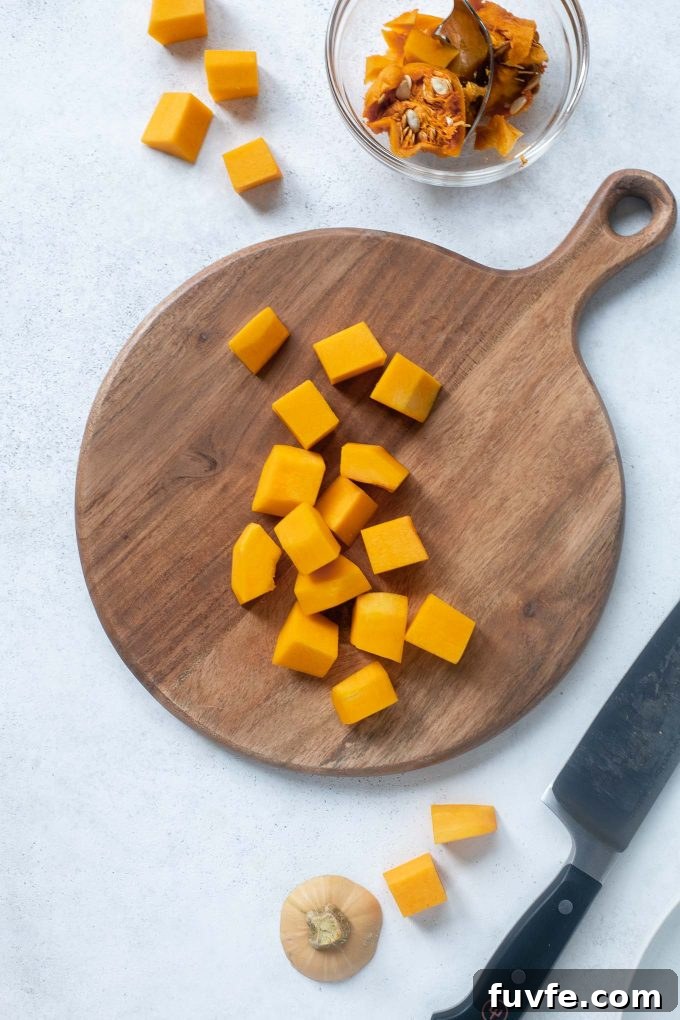
I look forward to winter squash season every year. Varieties like delicata, kabocha and butternut are favorites, and I use them in soups, salads, roasted side dishes and casseroles. Butternut squash is especially versatile, and while you can buy pre-cut cubes in many supermarkets, cutting your own is more economical and gives you better control over cube size.
With the simple techniques below, you can peel and cube a butternut squash in minutes. Once cubed, store the pieces in the refrigerator for a few days or freeze them for longer storage.
If you want to turn cooked squash into a smooth purée for casseroles or soups, cook the cubes until tender and blend until silky.
Table of contents
- Why you’ll love this
- Tools you’ll need
- How to peel butternut squash
- How to cut butternut squash
- Recipe FAQs
- How to use cubed butternut squash
- Notes
Why you’ll love this
- Simple, repeatable steps to peel and cube a butternut squash quickly.
- More cost effective than buying pre-cut squash—you’ll get more usable flesh for your money.
- Cubed squash works in soups, roasted vegetables, sheet-pan meals and meal prep.
- Store cubed squash in an airtight container in the refrigerator for 3–5 days, or freeze for up to 3 months.
Tools you’ll need
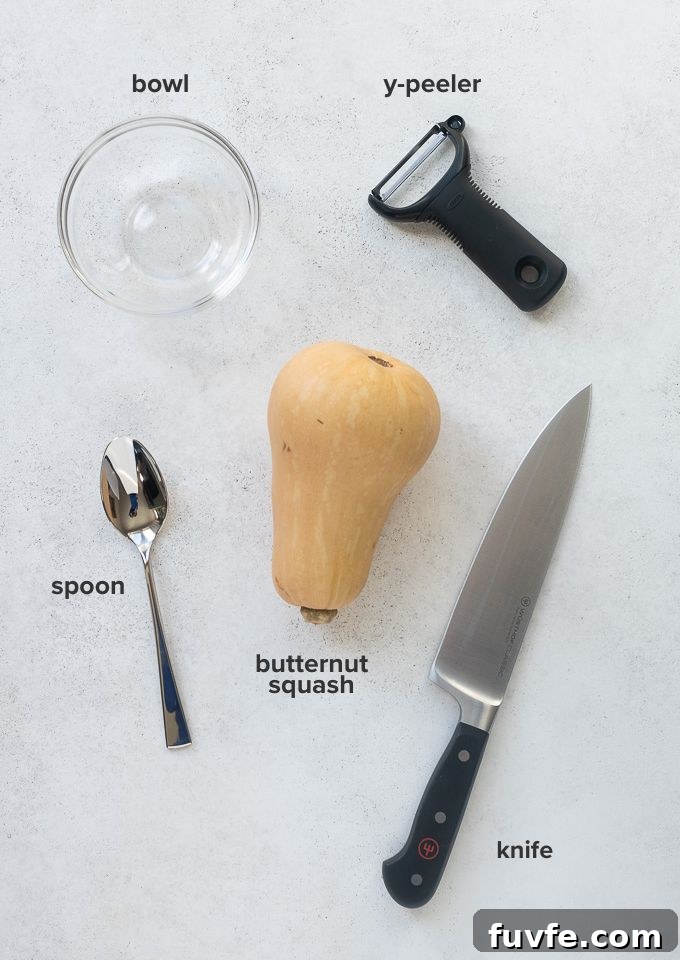
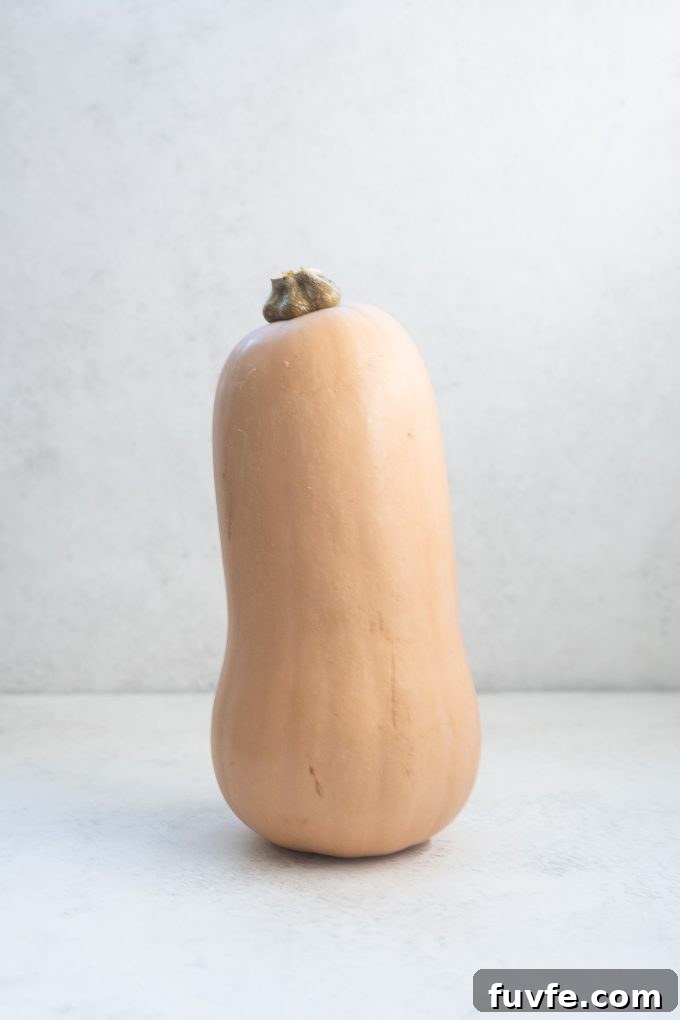
- Butternut squash. A 3 lb squash yields about 4 cups of cubed squash. Squash with a long neck is easiest to cut into uniform cubes.
- Large cutting board. Gives you space and stability while cutting.
- Sharp chef’s knife. A sharp blade makes peeling and slicing safer and easier.
- Y-peeler (optional). Useful if you prefer peeling with a peeler rather than a knife.
- Spoon. For scooping seeds from the bulb.
- Bowl. To collect seeds or scraps.
How to peel butternut squash
There are two reliable methods to remove the skin: using a y-peeler or cutting the peel away with a knife. The peel is thick, so remove it fully until you reach the orange flesh.
Pro tip: Using a sharp knife is often faster because you can strip away thicker skin sections in a single cut.
Remove the peel with a y-peeler
If you peel with a y-peeler, you may need to go over each area more than once to remove all the skin.
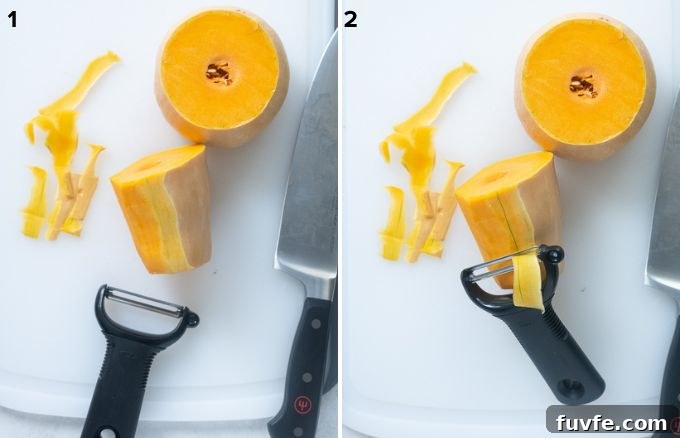
- Lay the squash flat and peel from left to right, or stand it at an angle and peel from top to bottom.
- Make sure you remove all the outer skin down to the orange flesh.
Remove the peel with a knife
This method is quicker for many cooks: you cut the skin away in sections while following the curve of the squash.
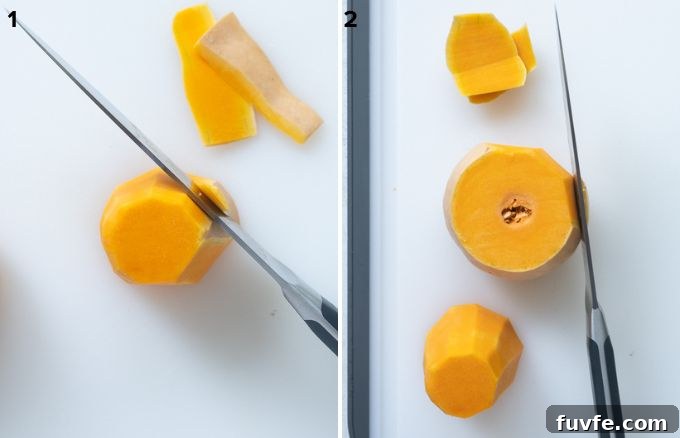
- Stand each squash section upright on the cutting board for stability.
- Slice off the skin in strips, following the contour of the bulb, until all skin is removed.
How to cut butternut squash
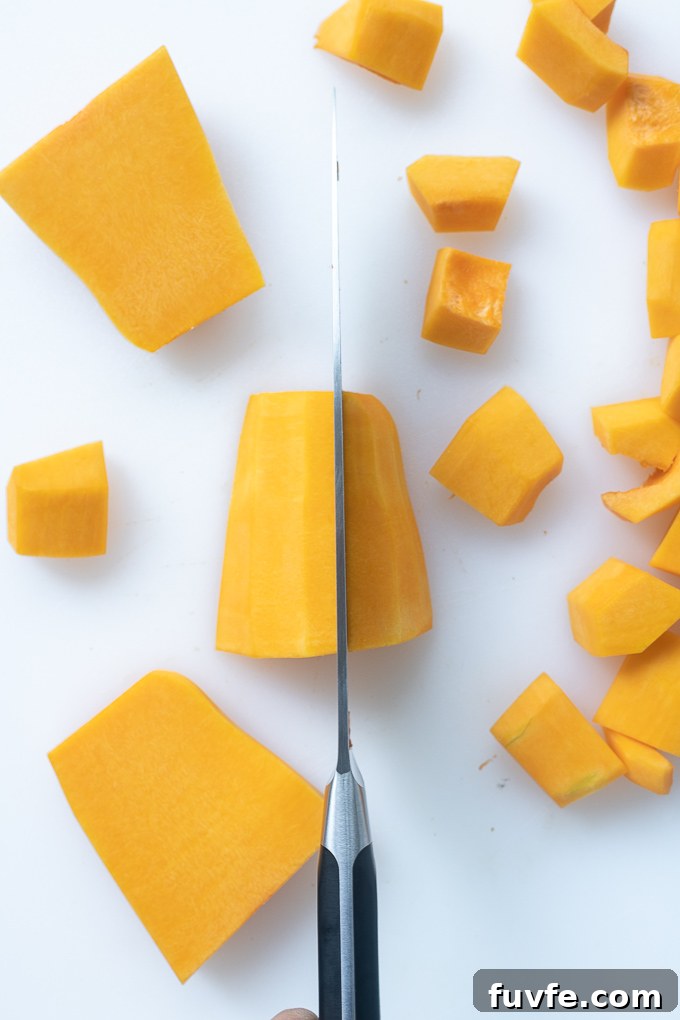
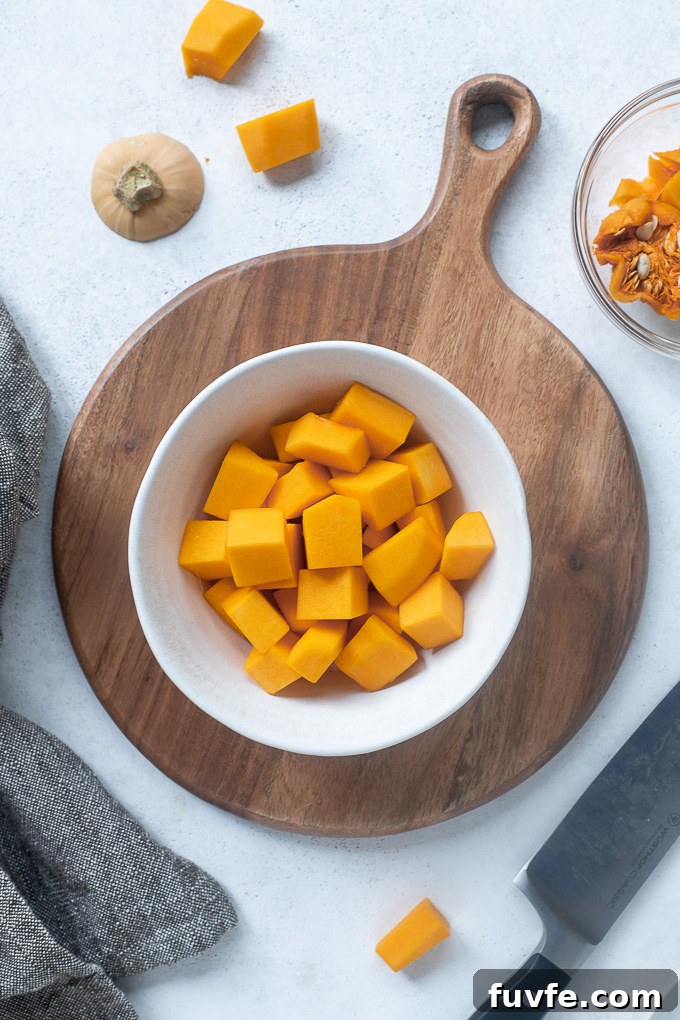
With the peel removed, cutting the squash into cubes is straightforward. Aim for consistent cube sizes (about 1–1½ inches) so the pieces cook evenly.
Pro tip: Buy squash with a long neck if you can—it’s easier to slice into uniform cubes.
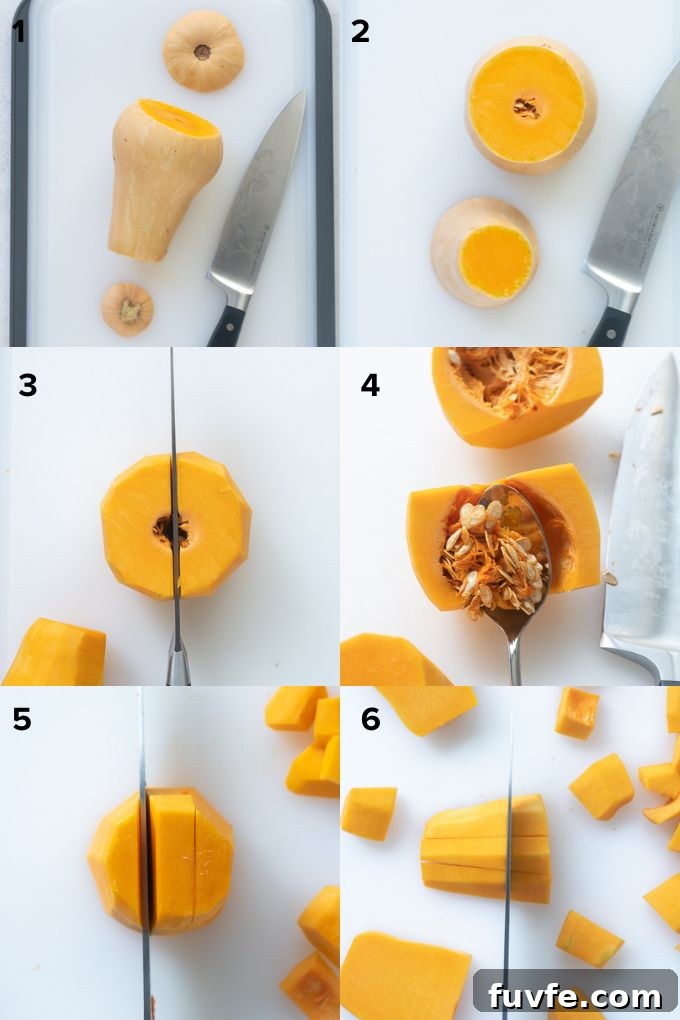
- Place the squash on its side and trim the top and bottom to create flat ends.
- Cut the squash into two pieces, separating the long neck from the bulbous base.
- Peel each piece using the method you prefer, then stand each piece upright and cut it in half lengthwise.
- Scoop the seeds from the bulb halves with a spoon.
- Lay each half cut-side down and slice into 1″ thick slabs.
- Cut the slabs into 1″ to 1½” cubes for even cooking.
Recipe FAQs
Choose a squash that feels heavy and firm for its size. Avoid ones with green patches, deep scratches or soft spots. A hollow sound when you tap it usually indicates ripeness. A long neck is convenient for even cubes.
Do you need to peel butternut squash?
Yes. The skin is thick and tough, so it should be removed before cooking. A sharp knife usually removes the skin more quickly than a peeler, but a sturdy y-peeler works too.
What is the easiest way to cut a butternut squash?
Trim the ends, cut the squash into neck and bulb sections, peel both pieces, stand them upright and halve them, scoop seeds from the bulb, then slice and cube the flesh into uniform pieces.
How to use cubed butternut squash
Cubed butternut squash works in many dishes:
- Roast with a touch of oil, salt and warm spices such as cinnamon or cumin for a simple side.
- Toss roasted cubes into salads for texture and color.
- Use cubes in grain salads, warm autumn soups, or mixed roasted-vegetable trays.
- Stir into risottos, casseroles, curries or roasted chicken dishes.
- Cook and blend into a smooth purée to substitute for pumpkin in recipes.
Notes
- Pro tip: Cutting the peel off with a knife often removes thicker skin more efficiently than a peeler.
- Try to cut cubes uniform in size (1–1½”) for even cooking.
- Yields: a small squash (~1.5 lb) gives about 2 cups cubed; a 3 lb squash yields about 4 cups.
- Storage: refrigerate cubed squash in an airtight container for 3–5 days or freeze for up to 3 months.
Did you try this technique? If so, share your results and photos to keep the inspiration going.
Quick recipe summary: How to Peel and Cut Butternut Squash
Servings: 8 (approximate). Prep time: 10 minutes. Total time: 10 minutes.
Equipment
- Large cutting board
- Sharp chef’s knife
- Y-peeler (optional)
- Spoon and bowl for seeds
Ingredients
- 3 lb butternut squash (or size desired)
Instructions
Peel the squash
- Either peel with a y-peeler by laying flat and peeling across, or stand the piece upright and remove the skin in strips with a sharp knife.
- Remove all skin until you reach the bright orange flesh.
Cut the squash
- On a cutting board, trim the top and bottom so the squash sits flat.
- Cut the squash into neck and bulb sections.
- Peel each section, then stand upright and slice in half lengthwise. Scoop seeds from the bulb with a spoon.
- Lay cut-side down and slice into 1″ thick pieces, then cut into 1″–1½” cubes.
Notes
- Cut cubes as evenly as possible for consistent cooking.
- Refrigerate cubed squash for up to 5 days or freeze for up to 3 months.
Nutrition (approximate per serving)
Calories: 77 kcal; Carbs: 20 g; Protein: 2 g; Fat: 0.2 g; Fiber: 3 g; Vitamin A and C are good sources.